Tiling over concrete: why an uncoupling membrane isn't optional here
Tile is rigid. Concrete moves — it shrinks as it cures, and in Calgary it heaves with every freeze-thaw. Bond tile straight to a slab and the slab's next crack becomes the tile's crack. An uncoupling membrane is the layer that lets the two disagree.
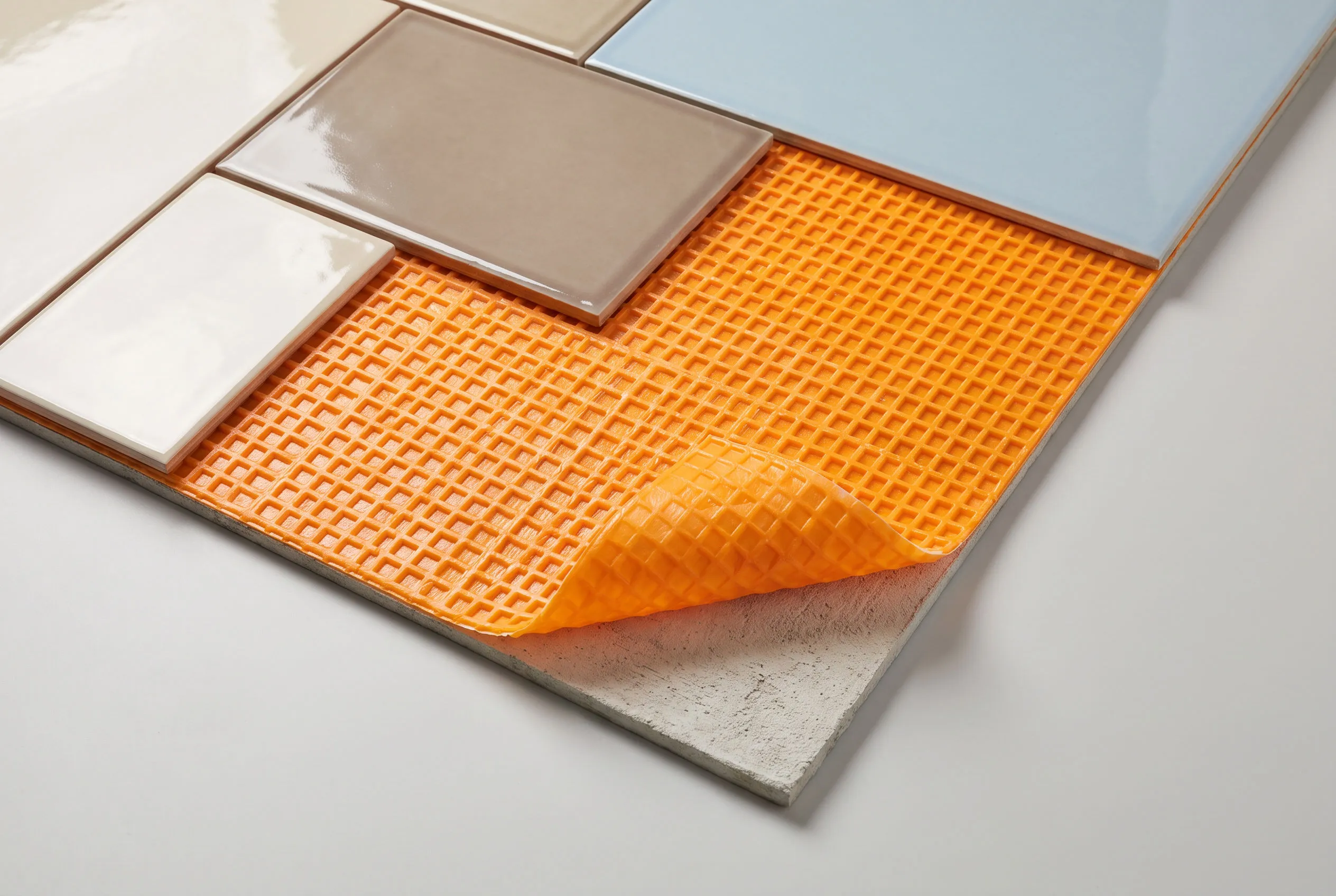
Tile is rigid. Concrete moves — it shrinks as it cures, and in Calgary it heaves and settles with every freeze-thaw. Bond tile straight to a slab and the slab’s next crack becomes the tile’s crack. An uncoupling membrane is the layer that lets the two disagree. Here’s how it works.
Why you can’t just glue tile to concrete
Concrete is never truly still. A new slab shrinks for months as it cures. An old slab moves with the ground beneath it — and in Calgary that means freeze-thaw: water in the soil expands every time it freezes, lifting whatever sits on top, then dropping it back in spring.
Tile and thinset are rigid. When the slab moves and the tile can’t, something has to give — a cracked tile, or a cracked grout line. The tile didn’t fail. The bond to a moving slab did.
What an uncoupling membrane does
DITRA is a thin membrane with a grid of open cavities. It’s bonded to the slab, and the tile is set on top of it. When the slab shifts, those cavities absorb the movement sideways, so it never transfers up into the tile. The two layers are free to move independently — that’s “uncoupling.”
Crack isolation, in plain terms
Lay tile straight on a slab and a crack in the concrete telegraphs right through — you get a matching crack in the tile, often within a season. Set it over an uncoupling membrane and the slab can crack while the tile above stays whole, because the membrane breaks the connection between them.
It’s called crack isolation, and it’s the single biggest reason a tile floor over concrete lasts in this climate.
Where it isn’t optional in Calgary
- Basements and slab-on-grade — closest to the freeze-thaw movement in the soil.
- Garages, mudrooms, entryways — the slabs that see the widest temperature swings.
- New construction — where the slab is still curing and shrinking under you.
Every concrete slab we tile gets a membrane. At $2–4 per square foot it’s a small line on the tile installation price guide — and the cheapest crack insurance in the build. If your floor is a Calgary basement, the freeze-thaw problem is worth understanding on its own: see tiling a Calgary basement.
When it’s done right, none of this is visible — which is exactly the point. It’s the invisible layer in tile installation that decides whether the floor is still flat and crack-free in five years.